
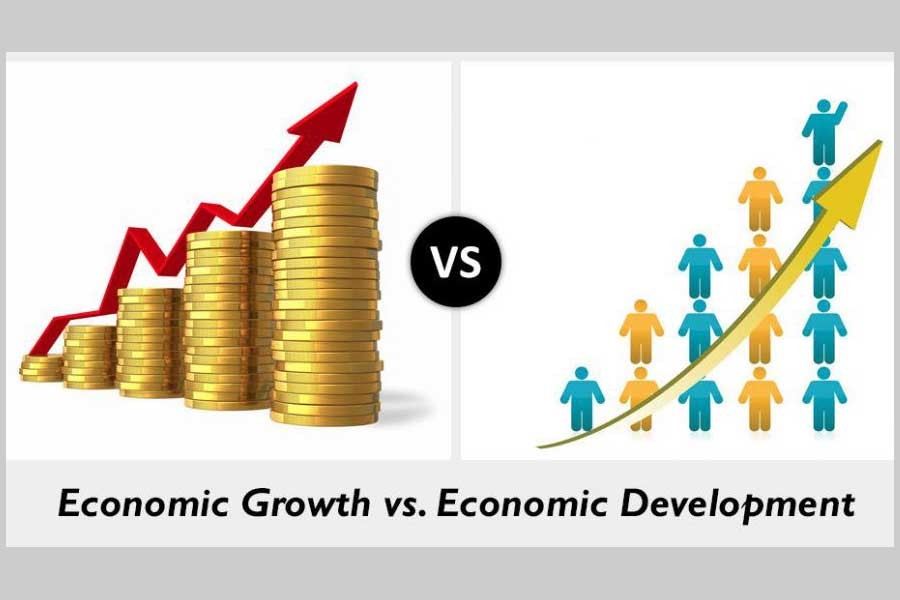
It is very clear by now that economic growth and economic development are two different things. Economic development is a broader criterion of measuring progress. Economic growth is a pre-requisite for economic development. Various measures and indicators have since been located which can help policy makers analyse country wise situations better. The indicators represent various aspects of economic growth - GDP growth (annual percentage), GDP per capita (current US$), import of goods and services (percentage of GDP), inflation (annual percentage), total reserves (includes gold, current US$), among others.
Incidentally, it may be mentioned here that World Development Indicators (WDI) are an extensive and holistic compilation of data by the World Bank on global development - having more than 1,300 time series development indicators featuring 214 nations and around 30 country groups. These indicators can be compared horizontally across countries, and are helpful to students, policymakers, analysts, officials, among others. The compilation of World Development Indicators, which is published annually (updated quarterly online in April, July, September and December), is definitely a result of years of hard work put in by many people, private organisations, officially recognised sources and government agencies at various levels.
Obviously, the development indicators located by the World Bank are a store of high quality data with coverage going back to the year 1960 (for most data) - extremely useful for many reasons, be it understanding the country-specific development or monitoring the progress in less developed nations. These indicators give a deep comparative and individual insight into all of the aspects which are linked to development and not just growth. What is more: these indicators additionally provide great information to investors or companies looking to invest outside their home nation, as they present a reliable and accurate picture of a country or region.
Actually, any study / scanning of development is important and at the same time interesting. It is important because in any economy, developed or developing, the scope for further economic and social development is always there through optimal utilisation of resources over a finite time and space. The challenge before the authorities is how to maintain the level of development already reached for ensuring a better life to its citizens and to aid trailers so that the latter can climb upon the development track. For the developing block, the challenge is all the more crucial and at the same time difficult especially considering the complexities of the globalisation process.
Newer techniques and innovention [innovation plus invention] process call for continuous searching and unearthing. Thus, the arena is interesting, more so because the process of development today is not well defined nor there exists any short cut routes!
Development is a characteristic of the system; sustained improvements in individual well-being are a yardstick by which it is judged. This has important implications for development policy, both for developing countries themselves wishing to put their economy and society onto a path of faster development, and for outsiders who want to help that process.
Especially, as of now the change has been so fast that it has become increasingly difficult to adapt quickly to the ever-changing processes where one technology is being fast substituted by the next one. The orthodox view - considering development as relating to the process of increasing the relative and absolute wealth of LEDCs [least economically developed countries] usually through notions of increased output of either industrial or agricultural goods - has also been under scanner. The modern age economists contend that development of LDCs [least developed countries] to the wealth levels of the richer OECD [Organization for Economic Cooperation and Development] nations, using extractive production and trading processes similar to those of OECD nations, is untenable because of the ecological and environmental damage which would ensue. New paradigm of development has no doubt, reasoning and validity considering the reality that has been increasingly there globally.
Who thought that cheaper flights will be contesting with the railways, sub prime crisis paving the topsy-turvy way to global meltdown, Satyam will be under scanner??
In fact development means 'upward drift of the entire social system', as rightly opined by Professor Samuelson. Truly, development studies as an area calls for an inter-disciplinary and multi-disciplinary approach where the economic factors are equally important as the non-economic factors so that all of the relevant issues of concern to developing economies in particular are addressed in a wholesome manner - regional studies, demography, economics, anthropology, management and essentially sociology, pedagogy, social policy, migration, human security, philosophy and ethics, international relations, gender issues.
It has the special focus on issues related to social and economic development and the relevance goes to communities and regions beyond the developing world. That is one of the foremost reasons why the area is attached much of importance by the leading global institutions - the World Bank, United Nations, Asian Development Bank and the like. Non-government Organisations as well as the private consultants also have a lot to borrow from this discipline.
Finally, today we are more and more concerned with sustainable development. The term sustainable development appeared in the late 1970s and was definitely consolidated in 1987 by the Brundtland Commission. This commission prepared the most broadly accepted definition of sustainable development: sustainable development is a transformation process in which the exploitation of resources, direction of investments, orientation of technological development and institutional change are reconciled and reinforces present and future potential, in order to attend to needs and future aspirations (...) it is that which attends to present needs without compromising the possibility of future generations attending their own needs (Becker, 1993, p. 49).
It could be said that sustainable development is that which provides or allows for the condition of the harmonious maintenance of man's well-being (economic, social and political) and the environment (ecosystem and space) to be attained.
Very judiciously, Sachs (2004) made some basic principles of this new developmental vision clear: satisfying basic needs; solidarity with future generations; participation by the population involved; preservation of natural resources and the environment in general; and then, preparation of a social system that guarantees employment, social security and respect for other cultures and education programmes.
The upshot: development is more than improvements in people's well-being: it also describes the capacity of the system to provide the circumstances for that continued well-being. Develop-ment is a characteristic of the system; sustained improvements in individual well-being are a yardstick by which it is judged. This has important implications for development policy, both for developing countries themselves wishing to put their economy and society onto a path of faster development, and for others who want to help that process. So, in the overall sense the focuses should be on: poverty reduction, HIV/AIDS, democratic governance, energy and environment, social development, and crisis prevention and recovery, while simultaneously encouraging the protection of human rights and the empowerment of women.
Dr B K Mukhopadhyay, a Management Economist, is Principal, ICFAI University, Tripura.