
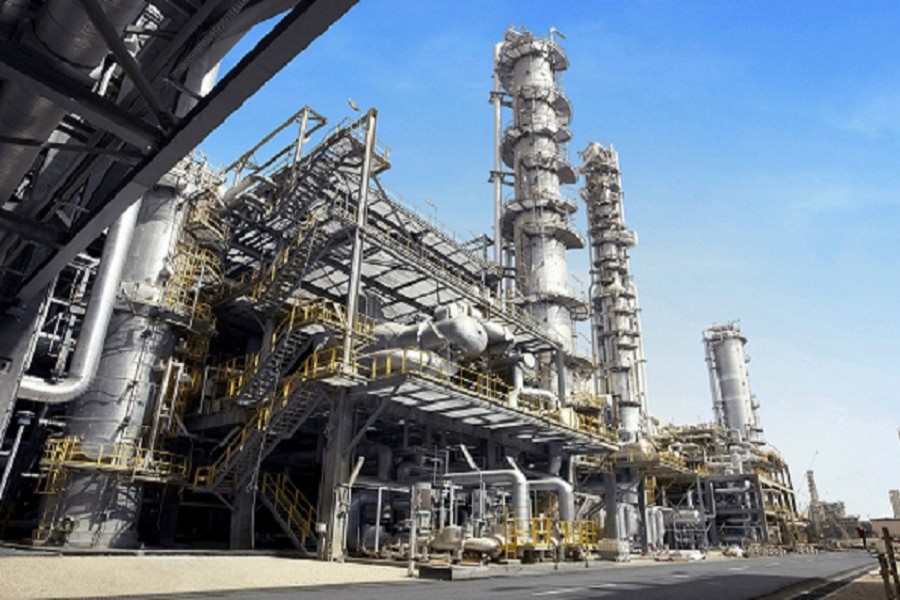
A dozen of the country's privately owned petrochemical and refinery plants have been shut from early this month, as the government has stopped supplying necessary raw material to maintain their operations, it has been alleged.
These fractionation plants use natural gas condensate, a low-density mixture of hydrocarbon liquids - present as gaseous components in the raw natural gas produced from the gas-fields, as their raw material to produce petroleum products like diesel, petrol and octane.
The state-run Petrobangla and its subsidiary natural gas producing companies had been supplying condensate to them to run their plants until June 30, president of the Petrochemical and Refiners Association of Bangladesh (PRAB) Md Mamun Salam told the FE on Wednesday.
He alleged that the state-run gas entities stopped supplying condensate to a total of 12 private refiners from July 01 'unilaterally' without prior notice.
As a result, bank loan worth around Tk 20 billion borrowed against their petrochemical and refinery plants remained stuck, and about 5,000 employees turned jobless, he added.
Mr Salam alleged that the government is neither supplying condensate nor allowing them to import it to run their factories.
But as per the licensing term, the government is bound to supply condensate or allow its import to keep their factories operational.
"We obtained license from the Energy and Mineral Resources Division (EMRD) under the Ministry of Power, Energy and Mineral Resources (MPEMR) to run our business."
Mr Salam said it is only the government that supplies raw material to them and takes back finished products from them.
The state-owned gas entities supplied condensate to these private fractionation plants, while the state-run Bangladesh Petroleum Corporation (BPC) purchased diesel, petrol and octane from them.
The PRAB has already submitted a letter, signed by Mr Salam, to the EMRD to reconsider the government's decision and initiate supplying condensate to its member companies.
Before closure, the privately owned petrochemical and refinery plants could produce around 80 research octane number (RON) gasoline, he said.
In the letter, the refiners committed to upgrade their product quality, if they were allowed to resume operations again with the initiation of condensate supply.
When contacted, EMRD Senior Secretary Md Anisur Rahman acknowledged that the government is not supplying condensate to 12 plants in this month.
He alleged that these fractionation plants had been supplying low-graded petroleum products for long, which caused damages to vehicles and other mechanical installations, using those products.
"Before the decision to halt condensate supply, we had given them time, and asked them several times to upgrade the quality of their petroleum products."
But they did not pay any heed, he alleged.
Besides, there is a High Court verdict, issued in January, to ensure production and use of environment friendly petroleum products, said Mr Rahman.
The country's overall production of condensate is around 12,000 barrels per day, of which 6,000 barrels are consumed by six state-run fractionation plants. The remaining 6,000 barrels are consumed by two privately owned petrochemical companies, which are not the PRAB members, said sources.
The two privately owned petrochemical companies, which get condensate from the government, have installed modern machinery and have better output of petroleum products, he added.