
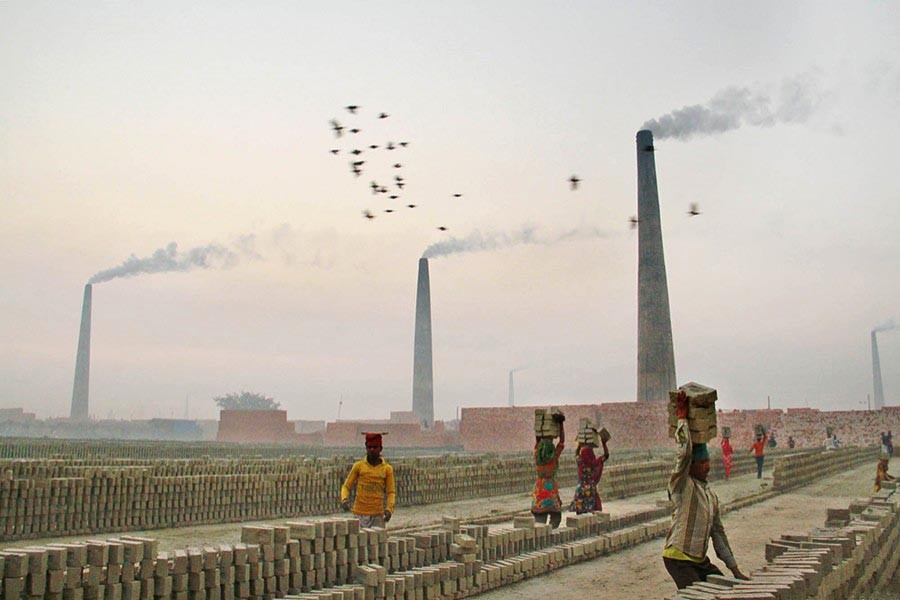
Smoke from outdated vehicles, brick kilns and industries, and dust from building work are key reasons of Dhaka's poor air quality, according to a new survey.
Besides, fume from garbage burning and trans-boundary air pollution are other causes of toxic air in the capital, it reveals.
The survey, conducted by the Centre for Atmospheric Pollution Studies (CAPS) under Stamford University Bangladesh, finds air quality in Dhaka was five times worse than the standard situation in 2019.
Air quality in Lalbagh, Sutrapur, Kamrangirchar and Kotwali areas in old part of the city and Tejgaon Industrial Area, Rampura, Badda and Mirpur in new Dhaka is the worst.
On the other hand, air quality in Pallabi and cantonment areas is comparatively better than other parts of the city, according to the survey.
Analysing air sample from 70 places across the city, CAPS revealed that presence of atmospheric particulate matter (PM) less than 2.5 micrometres is 307 microgram per cubic metre.
The rate is 4.72 times more than the tolerable level of PM 2.5 in the air which is 65 microgram per cubic metre, set by the Department of Environment.
CAPS director Prof Dr Ahmad Kamruzzaman Majumder said PM 2.5 refers to the size of about 3.0 per cent the diameter of a human hair.
Dust, inhalable particles, smoke, mist and others are considered as PM 2.5 that goes directly to the lungs while breathing, he told the FE.
He said Dhaka city very often tops the ranking of Air Quality Index which was also reflected in the survey.
Prof Majumder, also chairman of environmental science department, said it was earlier believed that brick kilns around the city are the key air pollutant.
"But our study found that Dhaka's air quality remains poor round the year while brick kilns remain operative for about 100 days a year from November to March."
The air has been continuously deteriorating because of the smoke produced by outdated vehicles and unregulated industries, Pro Majumder said.
ahb_mcj2009@yahoo.com