
Cyclone Amphan has severally affected coastal areas, and protecting next crop in the monsoon will be a major challenge.
Tk 4 billion can be allocated in repairing embankments to protect next crop.
Local government should be assigned to do this emergency construction while Water Development Board (WDB) could give technical assistance, and permanent maintenance responsibility of the embankment should be given to the local government.
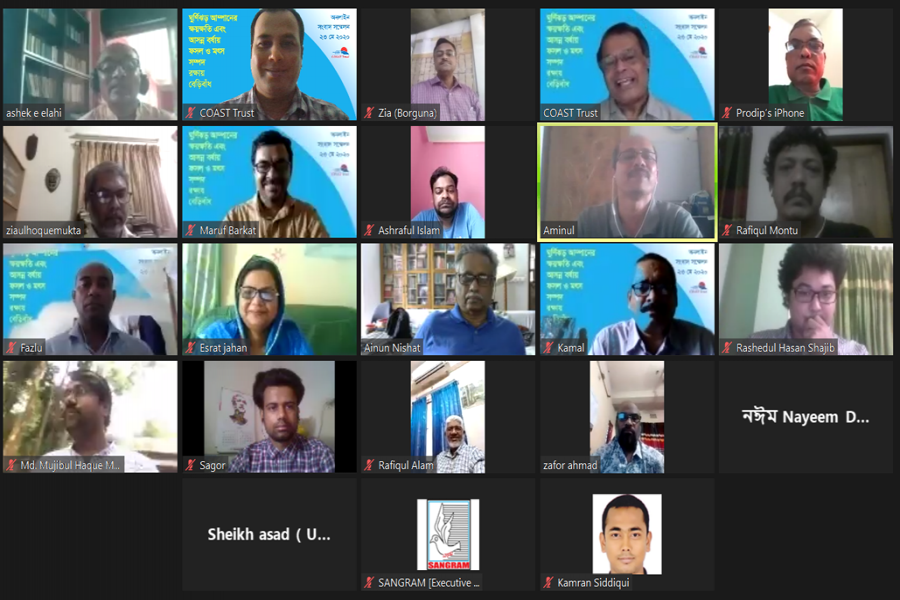
Syed Aminul Haque of COAST made the above recommendations at an online press conference on Saturday titled “Cyclone Amphan and emergency construction of embankment to protect next crop and fish resources in coastal area”.
10 coastal NGOs organised the event with the facilitation of COAST, a coastal NGO in Bangladesh, says a press release.
While giving the keynote presentation that depicted total damage of cyclone Amphan in the coastal area, Aminul mentioned that Satkhira and Khulna are the worst impacted districts. The total damage is agriculture 0.2 million hectare land, shrimp culture of Tk 3.4 billion, livestock of Tk 14 million, and 150 km embankment.
Dr Ainun Nishat of BRAC University, Nayeem Gowhar Wahra of Disaster Forum, Ziaul Haque Mukta and Prodip K Roy of Campaign for Sustainable Rural Livelihoods (CSRL), and Rafiqul Alam of Dwip Unnayan Sangsta (Hatiya) spoke at the press conference moderated by Rezaul Karim Chowdhury of COAST Trust.
Ashek E Elahi of Progoti (Sathkira), Sheikh Asad of Udayan Banglaesh (Bagerhat), Mr Ziaul Ahsan of PGUS (Pirojpur), Ziauddin Himu of CRUPDA (Barguna), Masum Chowdhury of Sangram (Barguna) and SK Liton of Kutubdia Press Club also attended the press conference.
Ashek E Elhai from Sathkira narrated the story of how mass mobilization with the initiatives from local government tried to protect the embankments during cyclone Amphan in his area.
Sheikh Asad from Bagerhat said how salty water in Bagerhat hampered livelihood due to drainage problem, and how WDB and local administration repeatedly failed to construct embankment on time because of their ‘contractor and sub-contractor system’.
Rafiqul Alam from Haitya who has long cyclone management experience since 1970, said that cyclone signal system is still from colonial period which is tailored to protect port instead of protecting people.
Zaiul Haque Mukta from CSRL said that even intervention from the prime minister of cyclone Aila WDB has failed to construct embankments on time due to their management complicacy.
He also narrated spontaneous mass mobilization all over coastal areas. People are trying their best in repairing and constructing embankments on short term basis.
Nayeem Gowhar Wahra of Disaster Forum placed the example from Charfession Bhola—participation of people and NGOs in maintaining the embankments. He proposed household based shelter system instead of making cyclone shelters and said 35 household based shelters could be constructed at the cost of one cyclone shelter. These types of households can be found in Kolapara.
Dr Ainun Nishat proposed that metrological department should be shifted to science and technology or to disaster ministry instead of defense. He termed present government approach mostly “relief approach” in respect of cyclone management which rather should be “disaster risk reduction approach”.
Rezaul Karim Chowdhury of COAST concluded that government institutions need reform and ownership of embankments should be given to people. He also said that we should not expect foreign funds like the past, we should mobilize our own resources for disaster management.