
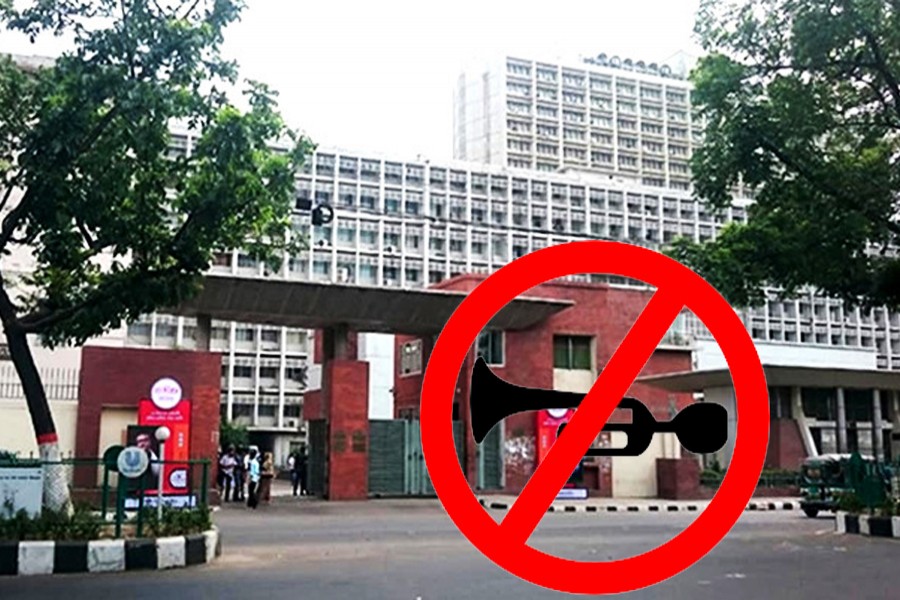
The noise pollution situation has worsened in the Secretariat area of the Dhaka city even after it was declared 'a no-horn zone', reveals a study.
The sound level in the secretariat area remained 70 decibels for about 88 per cent times which has increased to over 96 per cent after the declaration of 'no-horn zone' came.
Besides, the sound level in all the areas of the city was found to be much higher than the standard level.
Centre for Air Pollution Study (CAPS) of Stamford University and Bangladesh Poribesh Andolon (BAPA) revealed the findings of the study at a function at the Dhaka Reporters' Unity auditorium in the city on Friday.
BAPA and CAPS jointly conducted the study. BAPA executive chairman Abdul Matin chaired the function.
CAPS director Professor Ahmed Kamruzzaman Mazumder presented the findings of the study titled 'Dhaka City Dwellers Gripped by Severe Sound Pollution'.
The environment ministry declared the secretariat area 'a silent zone' on December 17 last year; yet honking could not be stopped in the neighbourhood even afterwards.
Rather blowing horns by the running vehicles has remained a major source of noise pollution for the area.
Mr Kamruzzaman said a study was conducted in the secretariat area from December 14 to December 22 before and after the declaration of the silent zone.
As many as 300 data were collected from each of the 12 points with the help of automatic sound level metre.
Although the standard sound level in the secretariat area was 50 decibels at daytime, it was never below 50 decibels during the survey period.
The sound level was over 70 decibels for 70 per cent of the time at 11 points while it was about 92 per cent combined at 12 points.
But the sound level remained over 70 decibels for the longest time at three points of the silent zone - Paltan Bus Stand 100 per cent time, Zero Point 99 per cent time, and Kadam Foara 99 per cent time.
The team also conducted a study on noise pollution at 70 points of the city.
The study found that the sound level was beyond the standard level for 100 per cent time in silent, residential and mixed areas (the standard sound level at silent zones is 50 decibels, in residential areas 55 decibels and in mixed areas 60 decibels).
In commercial areas the sound level was higher than the standard for 98 per cent times (the standard sound level in commercial areas is 70 decibels).
The sound level in the industrial areas was higher than standard for 72 per cent timed (the standard sound level for industrial zoned is 75 decibels).
Abdul Matin said that extreme sound level can cause heart attack. Sound pollution cannot be controlled by enacting law only. Awareness among people is very much necessary, he added.
Many government officials use three horns in their cars of which one is hydraulic, said Mr Matin.
"If these government officials do not care about law, then how come those bus and truck drivers will abide by the laws?" he asked.
BAPA general secretary Sharif Jamil said mindset of the policymakers must be changed along with undertaking and implementing coordinated and scientific short, medium and long-term plans.
The team also conducted a study on the impacts of noise pollution on the health of traffic policemen.
About 12 per cent traffic policemen said their hearing ability has reduced while 16 per cent cannot hear on mobile phones, 19 per cent watch television with more volume compared to other family members, 34 per cent cannot hear others in low voice, 8.0 per cent have been suffering from dizziness, nausea and fatigue while on duty for few hours.
Experts said noise pollution has become a serious environmental hazard in the city now-a-days.
Especially, future generation will be more affected both physically and mentally due to the menacing noise pollution.
Noise pollution reduces listening capacity and causes hearing loss, heart disease, short temperedness and study problems to students, among other damages.
msshova@gmail.com