
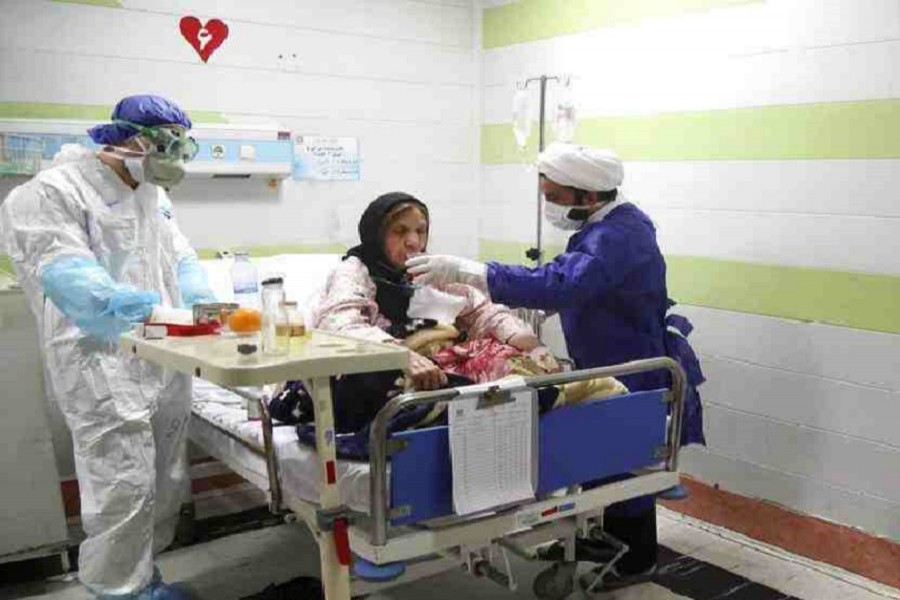
Coronavirus infections on a large scale among the health workers like doctors and nurses can worsen the situation in Bangladesh, which already has an acute shortage of such workers, compounded by their maldistribution, UNB reports.
The number of infected health workers has increased manifold alongside the surging overall caseload in the country.
Around 100 health workers, including 54 doctors, tested positive for Covid-19 as of April 14, according to Bangladesh Doctors’ Foundation (BDF). This number has likely increased further since then.
BDF founder and Chief Administrator Dr Nirupam Das said two doctors are undergoing treatment in ICUs while one has died so far.
Most of the doctors infected were in Dhaka and Narayanganj—two major clusters of community transmission of the SARS-CoV-2, the disease that causes Covid-19.
Dr Nirupam also said more than 300 healthcare professionals are currently in home-quarantine.
The figures on April 14 marked a threefold rise in the number of infected healthcare professionals in just a few days.
Bangladesh accounts for an estimated 3.05 physicians per 10,000 population and 1.07 nurses per 10,000 population (estimates based on MoHFW HRD 2011). There is also a severe gap between sanctioned and filled health worker positions in the country: 36 per cent of sanctioned health worker positions lie vacant.
Meanwhile, fewer than a third of healthcare facilities (32 percent) have three-fourths or more of the sanctioned staff working in the facilities (World Bank, 2009).
The danger of being infected has been a persistent concern within the community of healthcare workers, particularly doctors and nurses. They are daunted by the alarming rate of infection and increasing trend.
Doctors and nurses working in public hospitals shared their anxieties over the dilemma they face with the news agency, understandably on condition of anonymity.
As the number of infections is increasing day by day, many frontline healthcare workers are facing the ultimate challenge in collecting samples to detect the virus, for which one medical technologist is deployed in every upazila of the country. The Health Department directed them to collect 10 to 20 samples a day in their areas.
Although no up-to-date collated figures are available, the Coronavirus Resource Centre at Medscape, the online resource for doctors, collects and publishes a list of health workers who have become victims of COVID-19 in different countries of the world. The current list already includes hundreds of names, and it is updated almost every day.
As far back as 2011, the World Health Organization declared Bangladesh as one of 58 ‘crisis countries’ facing an acute shortage of human resources in healthcare, based on the number of formally qualified, registered Health Care Providers (HCP), i.e. doctors (or physicians), nurses, and dentists in the country.
The HCP density was measured per 10, 000 of population. There were “approximately five physicians and two nurses per 10 000, with the ratio of nurse to physician being only 0.4.”
Substantial variation among different divisions was also found, with “gross imbalance” in distribution favouring the urban areas.
None of it bodes well for dealing with the local outbreak during a pandemic.