
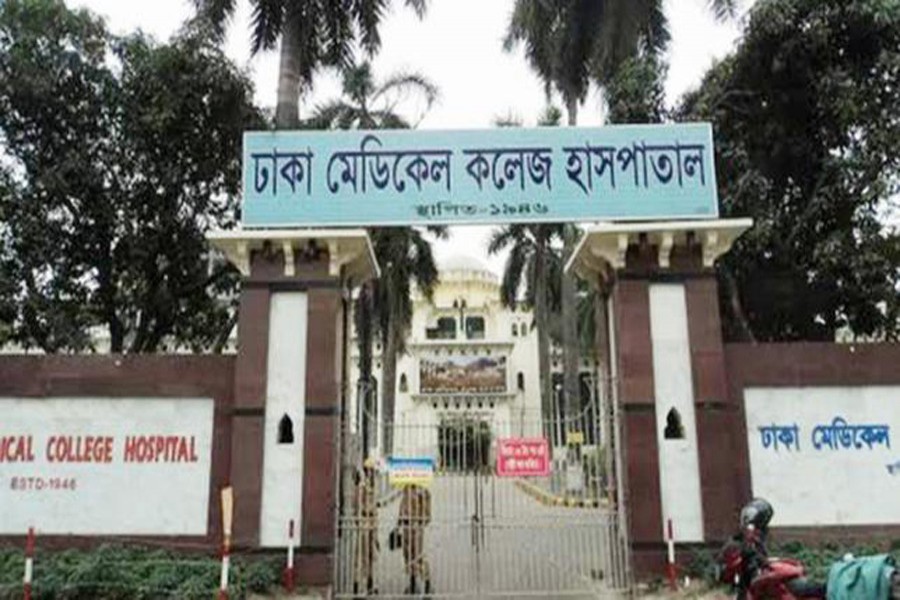
Dhaka Medical College Hospital (DMCH) initiates a study of 'convalescent plasma therapy' on Covid-19 cases today (Saturday).
Under the study, blood plasma will be collected from some donors, who won the battle against novel coronavirus, and transfused into severe and critically ill corona patients admitted to the hospital.
Initially, the study will be conducted on 45 patients. The result is expected to come within 30 to 45 days.
The Directorate general of health services (DGHS) has decided to try plasma therapy, but the final approval of the protocol involving remains pending with Bangladesh Medical Research Council (BMRC).
The DGHS prepared the protocol on April 27.
The ethical review board of the DMCH earlier grant its permission to conduct the study.
Convalescent plasma therapy is a century-old technique used to infuse antibodies into the critically ill patients who have few treatment options left.
In this treatment, plasma is separated from the blood donated by people, who make their recovery from highly contagious diseases. The plasma that contains antibodies is infused into critically ill patients.
Talking to the FE, DMCH head of haematology and bone marrow transplant unit Prof Dr MA Khan said three persons have enlisted their names for donating blood today (Saturday).
The necessary reagent for testing antibody titre will arrive from Spain within next two days.
Cure Smile Bangladesh Foundation chief executive officer Dr Tanvir Islam is donating a kit.
The work on antibody detection and citation will be done in their lab.
"We'll create a plasma bank and the hospitals who will come to terms with us will only get plasma for transfusion as it's still a study," Dr Khan said.
"The doctors of the hospitals concerned will be engaged for clinical as well as laboratory follow-up of those patients who will be given the therapy."
The therapy will cost an estimated Tk 12,000 and the kit costs Tk 0.6 million, Dr Khan mentioned.
"We'll open the plasma bank to all only when the government assures us of grant money," he said.
About patients' criteria, he said those who will be admitted to hospitals with breathing problems requiring oxygen or are in a critical condition under ICU can be given plasma therapy.
Dr Khan said the DG office has sent a list of the Covid-19 cases who have recovered. But plasma will only be collected from male patients aged between 18 and 50 after necessary screening.
As many as 3,882 out of the 20,065 officially detected Covid-19 patients in Bangladesh have recovered.
The DMCH has not yet analysed how many of the recovered are between 18 and 50 years.
A DMCH source said they are sending SMS and contacting over phones the recovered patients to donate plasma, but the response until now is poor. A few doctors have responded.
Regarding donors' preferences, the source said female donors can only donate plasma before pregnancy. Besides, those with uncontrolled hypertension and insulin-dependent diabetes cannot donate plasma.
The DMCH will collect plasma following the donors' guideline of the World Health Organisation.
The most challenging job is the citation of blood.
There are three 15-18 apheresis machines at public and private hospitals. The DMCH, NICVD, Bangabandhu Sheikh Mujib Medical University and Neuroscience Hospital have the machines.
It takes one hour and a half to prepare 200 millilitre plasma from a person's blood by this machine.
One machine can collect plasma of 10-12 persons a day by engaging maximum manpower.
Apheresis machine is a medical technology in which a person's blood is passed through an apparatus that separates one particular constituent and returns the remainder to circulation.
It is, thus, an extracorporeal therapy. The apheresis machine is used for collecting stem cells.
Dr Khan said a kit, which costs Tk 0.19 million, can test 96 blood samples to count antibody.
"We'll test blood samples even if it's 10 to 12 only and won't wait for 96," he said.
When asked, additional secretary of health ministry Habibur Rahman Khan told the FE that the clinical trial of plasma therapy is under process.
The DMCH will have to complete necessary steps and get approval from the BMRC and drug administration.
The government will then decide on the financing process of the therapy of those patients who will be receiving treatment at public hospitals, he concluded.