
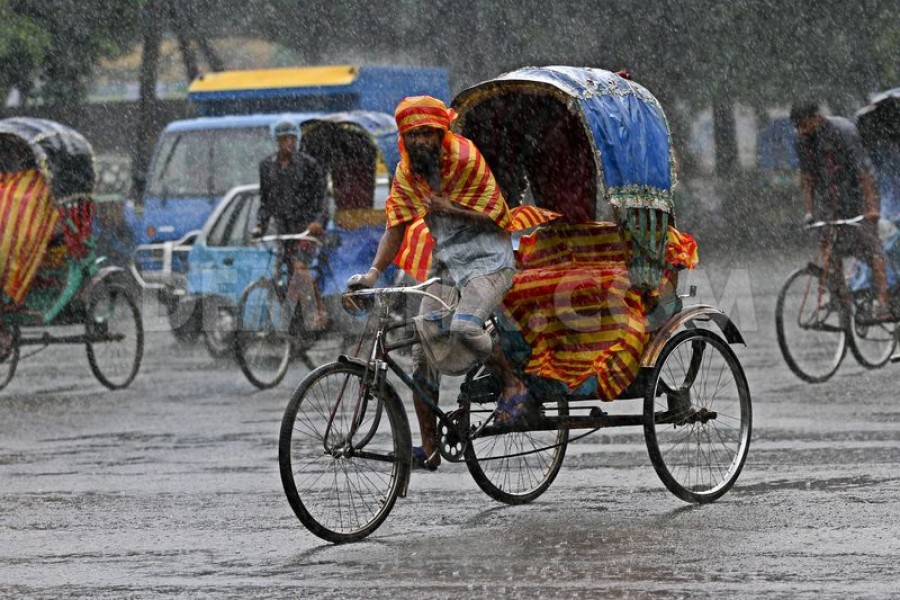
Rainfall in the drought-prone northern region in the country is going to increase significantly in future for the consequence of climate change thus posing serious threat to the agro-ecology.
However, drought is going to shift to the central and southern parts of the country for the same reason, the latest study revealed.
Though overall drought might decrease for increasing rainfall, extreme drought days are likely to increase in most of the cropping seasons which may affect agricultural production in the future, driven by the increasing pattern of consecutive dry days, the study said.
The research, styled 'Future Changes in Precipitation and Drought Characteristics over Bangladesh Under CMIP5 Climatological Projections,' is based on next ninety-year rain and drought forecast of the country.
It revealed that rainfall of Bangladesh will increase by up to 26.3 per cent in 2010-2039 period than the baseline of 1976-2005.
Total rainfall will increase by up to 53 per cent within 2099, the paper said.
The study, conducted jointly by Mohammad Kamruzzaman, Min-Won Jang, Jaepil Cho and Syewoon Hwang was published in MDPI, a global digital publisher, on October 24.
The changes in rain and drought characteristics were assessed for the beginning (2010-2039), middle (2040-2069), and end of this century (2070-2099) taking 1976-2005 as baseline.
The researchers prepared the report base on 30-year readings of the country's rainfall, dry days, temperature and other issues.
However, according to the report, the annual rainfall in the region varies from 1536 mm to 4124 mm during 1976 and 2005, and the 30-year averaged annual rainfall was 2410 mm.
The study revealed that overall precipitation (rain) trends are likely to increase in the future over this region.
For the beginning of the century (the 2010s), Bangladesh is expected to face an increase of up 26.23 per cent in rainfall, compared to the baseline period.
In particular, the maximum increases were located on the border between the Natore, Panbna, and Kustia districts, it said.
However, the most significant increase of rainfall, up to 35.67 per cent, was projected during the middle of the century (the 2040s), especially in the districts in the northern region, and the increasing trend grew more severe with time.
Growth of up to 53.95 per cent in rainfall was also projected to occur under by the end of the century (the 2070s) over Bangladesh.
The highest increase in rainfall is expected to happen over the northern region of Bangladesh, especially districts in the Dinajpur and Rajshahi divisions.
However, the increasing trend of precipitation may generally imply a decrease in drought occurrence, it said.
"Changes in the frequency of precipitation events were also manifest as changes in the duration of dry spells (consecutive dry days, CDD) and wet spells (consecutive wet days, CWD), the study said.
The highest CDD rise might occur at the end of the century (the 2070s) by around 12.08 per cent followed by approximately 9.57 per cent in the middle of the century.
Extreme drought days in places will also increase by 15 per cent especially during the Kharip cropping season, it said.
But the study said overall drought in the country would decrease.
Moderate drought will decline by around 9 per cent and 14 per cent respectively within 2039.
However, the impacts of climate change on precipitation and drought characteristics over Bangladesh were examined by using the daily precipitation outputs from 29 bias-corrected general circulation models for the study.
Dr Wais Kabir, chairman of Bangladesh Krishi Gobeshona Foundation, told the FE that climate change is no more a future threat as we already are experiencing its consequences.
He said it has been changing regional hydrological patterns as well as the characteristics of rain and droughts, which could lead to severe disasters in agro-based country like Bangladesh.
He said the country has been experiencing both flood and drought conditions recurrently over the past several years.
He said flood caused damage to 10 per cent of rice in 2017 while drought caused severe blow to crops in the northern region in 2006. He said production decreased by 30 due to the effects of drought in the region for the drought.
The effects of gradual climate changes and extreme weather events may negatively impact overall socio-economic development in many regions, he said.
"The scientific community and planners need more information about the probability of future occurrences of such events to frame our future agricultural and economic policy," he said.
tonmoy.wardad@gmail.com