
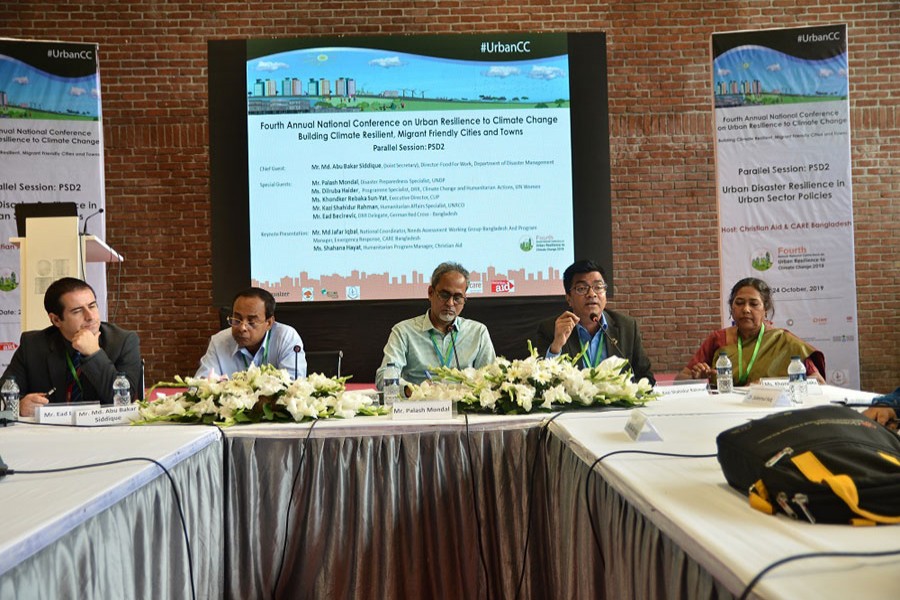
CARE Bangladesh and Christian Aid jointly organised a session on “Urban disaster resilience in urban sector policies” in the fourth annual national conference on Urban Resilience to Climate Change at the Institute of Architects Bangladesh, Agargaon, Dhaka on Thursday.
Md Abu Bakar Siddique, joint secretary, director- Food for Work, Department of Disaster Management attended the session as the chief guest. The discussants of the session included Palash Mondal, disaster preparedness specialist, UNDP; EadBecirevic, DRR Delegate, German Red Cross; Kazi Shahidur Rahman, humanitarian programme specialist, United Nations Information Centre (UNRC) and Khondker Rebaka Sun-Yat, executive director, Coalition for the Urban Poor (CUP).
The discussant in the session highlighted that urban Bangladesh faces many vulnerabilities including earthquake, fire, water logging, flood, building collapse, air-chemical-sound pollution. Though the government of Bangladesh developed and implemented a number of policies, strategies and tools for disaster risk reduction (DRR), there still exists a large gap in urban-specific DRR framework in Bangladesh. The current tools and methodologies are not particularly applicable for urban disaster needs assessment.
The session key note was presented by Jafar Iqbal, national coordinator, Needs Assessment Working Group-Bangladesh and Programme Manager, Emergency Response of CARE Bangladesh and Shahana Hayat, Humanitarian Program Manager of Christian Aid.
Recommendations came to update the current policy framework with amendment or adopting new policies related to urban resilience. It is also critical to adopt urban specific Joint Need Assessment tools to ensure disaster resilient urban Bangladesh by 2030.
Founded in 1945, CARE is a leading humanitarian organisation fighting global poverty. CARE places special focus on working alongside poor girls and women because, equipped with the proper resources, they have the power to lift whole families and entire communities out of poverty. Last year CARE worked in 95 countries and reached more than 56 million people around the world, says a press release.