
Bangladesh still relies on the British-era storm warning system despite being one of the countries which are most vulnerable to natural disasters.
However, almost every country in the world has ensured up gradation of the warning system.
The work to upgrade the system has been under way for three decades, but there is no progress as Bangladesh Meteorological Department sticks to the old signals arguing that the people have become more used to them.
Md Mohsin, director general of the Department of Disaster Management, said the 10-level warning system is not inconsistent with international standards, reports bdnews24.com.
“We can present this to the people easily and take preparations accordingly. These signals have clear meanings to the people,” he said.
The old system was made for ports and ships with less importance on the safety of residents in the coastal areas.
The authorities do not need to hoist any flag for signals nos. 1 to 3 that advise verbal discussion on formation of a depression or cyclone.
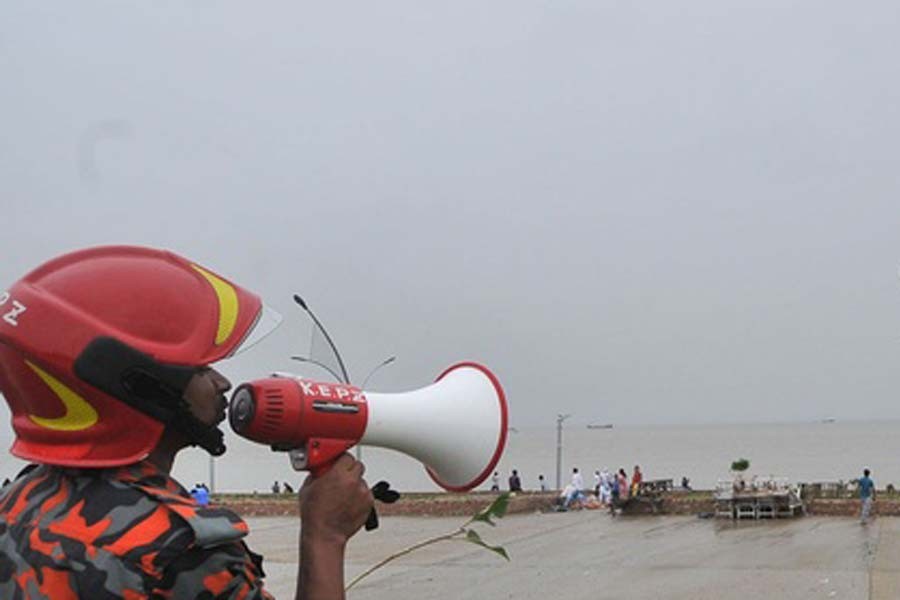
Signal No 4 means hoisting one flag to raise awareness on formation of the cyclone and the possibility of its impact and addressing the public through megaphones and loudspeakers.
Signals 5 to 7 are danger signals with two flags when the authorities prepare for evacuation and address the public through megaphones and loudspeakers.
Signals 8 to 10 indicate great danger. It requires the use of static and hand sirens and ensuring evacuation.
There is another signal beyond these levels – Great Danger Signal No. 11 means communication is destroyed.
There are separate signals for inland ports and water transport system as well.
But putting more than one signal in one tier, such as danger or great danger, may confuse the people.
Even Britain ditched the system a long time ago. Most countries use warning signals with five colours that are based on how far and strong a storm has become.
In Bangladesh, disaster management and relief ministry recommended integrated warning signals for the seaports and river ports during the preparation of a master plan for the construction of cyclone shelters in 1992-93.
The government formed a committee with the chiefs of the Met Office, Disaster Management Bureau, Water Development Board, Space Research and Remote Sensing Organisation, and Storm Warning Centre at the time to modernise and simplify the signal system for members of the public.
No initiative had been taken to implement the recommendations of the committee.
Another committee, headed by Professor Jamilur Reza Choudhury was formed to review the previous committee’s report during the 2007-08 caretaker government after cyclone Sidr devastated coastal regions in November 2006.
It submitted a report to the disaster management ministry in January 2007, emphasising the importance of warning the people as well as ships and ports.
The committee recommended reducing the number of warning signals by merging signal numbers 3, 5, 6, 7 and 9 with the others.
In 2009, the ministry cut the total 15 signals for river and maritime ports down to eight and proposed their implementation from the next year. But to date, it has not happened