
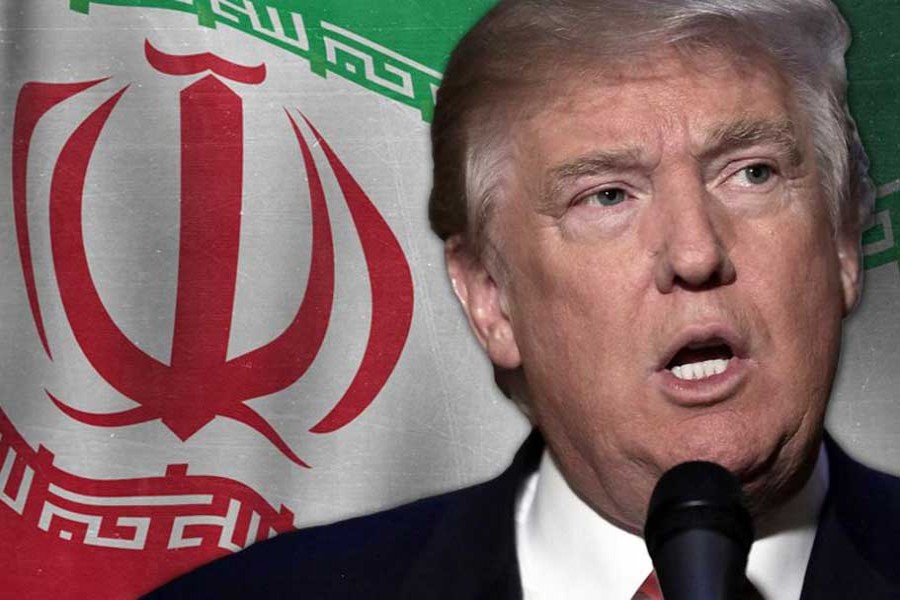
As expected, on October 13, US President Donald Trump announced through a combative speech his plan to withdraw the backing of the United States from the multi-party nuclear accord with Iran. Through this, he has initiated a more confrontational strategy. In his speech he observed: "Worst of all, the deal allows Iran to continue developing certain elements of its nuclear programme. And importantly, in just a few years, as key restrictions disappear, Iran can sprint towards a rapid nuclear weapons breakout. In other words, we got weak inspections in exchange for no more than a purely short-term and temporary delay in Iran's path to nuclear weapons."
Analysts have pointed out that this move would not mean immediate withdrawal of the US from the deal. However, it would give the US Congress 60 days' time to decide whether to do so by re-imposing sanctions. Trump has also remarked that "In the event we are not able to reach a solution working with Congress and our allies, then the agreement will be terminated. It is under continuous review and our participation can be cancelled by me, as President, at any time."
Under the 2015 accord, Iran agreed to freeze its nuclear programme in return for the partial lifting of sanctions. This deal also required the US President to certify every 90 days that Iran was upholding its part of the agreement. Such certification had already been done by Trump twice since his assumption of Office. The third was due in the near future.
This latest crisis emerged as Trump, in keeping with his criticism of the Iran nuclear accord during the presidential campaign as the "worst deal ever negotiated", was planning to scrap the deal. This had caused alarm among US allies and also among some members of Trump's own administration.
Nancy Pelosi, the top Democrat in the US House of Representatives, has called Trump's move "a grave mistake" that threatens the security and credibility of the US. She has said that Trump had ignored "the overwhelming consensus of nuclear scientists, national security experts, generals and his own cabinet, including, reportedly, his Secretary of Defence and Secretary of State". US Defence Secretary James Mattis also told a Senate hearing earlier this month that it would not be in the national interest of US to abandon the agreement.
THE NUCLEAR ACCORD: The 2015 Joint Comprehensive Plan of Action (JCPOA) is designed to prevent Iran from developing a nuclear weapon. However, it lifted some sanctions that had stopped Iran from trading on international markets and selling its energy resources. Members of the international community involved in drafting the nuclear agreement between Iran and the P5+1 group of world powers included the US, UK, France, China and Russia - all permanent members of UN Security Council - plus Germany.
In July 2015, Iran had almost 20,000 centrifuges. Under JCPOA, it was limited to installing no more than 5,060 of the oldest and least efficient centrifuges at Natanz in Central Iran for 10 years. In addition, it was agreed that research and development would take place only at Natanz and be limited for eight years. No enrichment would also be permitted at Fordo, another nuclear facility near Natanz for 15 years, and the underground facilities would be converted into a nuclear, physics and technology centre. The 1,044 centrifuges at the site would only produce radioisotopes for use in medicine, agriculture, industry and science. It was also stipulated that Iran's uranium stockpile would be reduced by 98 per cent to 300kg (660lbs) for 15 years and that Iran needed to keep its level of enrichment at 3.67 per cent.
Under the accord, Iran agreed in principle to permit Inspectors from the IAEA, the global nuclear watchdog, to continuously monitor its declared nuclear sites and also verify that no fissile material is moved covertly to a secret location to build a bomb. Iran also agreed to implement the Additional Protocol to their IAEA Safeguards Agreement, which would allow inspectors access to any site anywhere in the country they deemed as suspicious. For the next 15 years, Iran would have 24 days to comply with any IAEA access request. If this was refused, an eight-member Joint Commission - including Iran - could then rule on the issue. It could then decide on punitive steps, including the re-imposition of sanctions. A majority vote by the Commission would suffice. Iran also agreed to the continuation of the UN arms embargo on the country for up to five years; although it could end earlier if the IAEA was satisfied that its nuclear programme was entirely peaceful.
Sanctions imposed by the UN, US and EU crippled Iran's economy. Iran was eventually forced to agree to JCPOA. Iran understood that by agreeing to the conditions of the JCPOA, it stood not only to gain access to more than $100 billion in assets frozen overseas but also that it would be able to resume selling oil on international markets and using the global financial system for trade. Later on, consistent with JCPOA, $100 billion of frozen Iranian assets were released and Iran was also allowed to trade its oil and gas in the world market, allowing it to earn over $41bn in the fiscal year that ended in March 2017. The prospect of peace encouraged tourism. During the same period, tourism revenue increased, hitting six million visitors, with estimated revenue of $8 billion.
REACTION TO TRUMP'S STATEMENT: International response to Trump's statement has been critical to say the least. European leaders have taken the unusual step of publicly calling on the US to abide by the deal and have affirmed that Iran is upholding its commitments under JCPOA.
In response to Trump, Iranian President Hassan Rouhani has said the US could not change the undertakings within the deal unilaterally. Yukiya Amano, head of the International Atomic Energy Agency (IAEA), has noted that Iran has been implementing the deal and is subject to "the world's most robust nuclear verification regime". Similarly, EU foreign policy chief Federica Mogherini has described the deal as "robust" and said there had been "no violations" by Iran. She has remarked that it was not in the power of "any President in the world" to terminate the agreement. United Nations Secretary-General Antonio Guterres has expressed "hopes" that the nuclear deal with Iran can be salvaged as this has been a "very important breakthrough to consolidate nuclear non-proliferation and advance global peace and security".
In a joint statement the UK, Germany and France, while expressing their concern about Mr Trump's move, have reiterated that they remained committed to the deal. The British Embassy in Washington, DC has taken the unusual step of posting an animation on Twitter showing how Iran was complying with the deal. French President Macron has told the US that not honouring its side of the deal could push Iran to producing a nuclear weapon in the future. Russia has said that it remained committed to the deal and was opposed to the use of "aggressive and threatening rhetoric in international relations".
On the other hand, Israeli Prime Minister Benjamin Netanyahu has congratulated Mr Trump for having "boldly confronted Iran's terrorist regime". Saudi Arabia has also backed the US President's "firm strategy".
Ultra- conservative supporters of Trump have remarked that this outpouring of support for Iran by Europe is because European states have enjoyed burgeoning trade ties with Iran since the deal came into force.
To conclude, whether the Trump Administration likes it or not, Iran, today, is a major player in the Middle East and that region's future stability depends on it.
The writer, a former Ambassador and Chief Information Commissioner of the Information Commission, is an analyst specialised in foreign affairs, right to information and good governance.
muhammadzamir0@gmail.com